Friday, January 18, 2013

Devil is in the Details - Publishing Contracts

About two weeks ago, I received a publishing offer for my book, Maker of Angels. I was thrilled! My first impulse was to sign the deal and schedule a celebratory pizza feast for my family, friends and any nameless strangers who might like to join the party. What did I do?

Three fist pumps, a couple quick posts and private emails to share my anticipated good fortune. Then, I got to work.

I read every word of the document—every stinking word! Funny how legal clauses are boring until your future might be made or broken by some obscure provision. I discovered typos and disturbing questions about some of the provisions, but how do you question a contract offer for which you’ve been desperately hoping?

Will they think I’m a pain-in-the-rear, a Prima Dona author and withdraw the deal? If they do that, I rationalized, I’m better off without them.

Devil is in the details!
I hit the “send” button on my email list of questions and crossed my fingers, but I didn’t wait for answers. There was still more work to be done. An old adage in business is that a company can promise you anything as long as they can go bankrupt and get out of the deal. For this reason, the history of the publishing company is important. Are they financially substantial? Do they have any bad reports in industry watchdogs like Predators and Editors?
 
This company checked out okay. I even interviewed one of their newer authors to see what her experience was like. She gave a good report.

Everything seemed to be adding up. Nevertheless, doubts nagged at me. I studied their website for hours. Pricing of e-books seemed high, particularly for my anticipated genre. And, their POD book pricing was typical—way over the usual market price for comparable trade paperbacks. Contractual language only allowed for a “limited” run of traditionally printed books and while they claimed to have lots of distribution outlets, they could not provide Barnes & Noble for widespread marketing. I worried that my books might be overpriced and poorly distributed.
 
Meanwhile, contract changes arrived by email. The company impressed me with their willingness to negotiate, but one concern really bothered me. Charging authors a fee for services. When I mentioned that it felt like a vanity press, the owner of the company argued it was reasonable and not even a “fee,” calling it some convoluted refundable deposit or some nonsense like that.

Now, I’ll admit, I’m a simple man. But, if it looks like a duck, walks like a duck, and quacks like a duck . . . it’s a duck!

The company owner came across as aloof, and defended their publishing concept of charging authors for publishing. Her company policy of over-pricing books so they can offer false economy by showing big discounts was pure gimmickry to me. Do they think readers are stupid? My philosophy is to charge a fair price, one that is competitive in the genre’s market, and then deliver a superior product, i.e. quality story-telling. Word of mouth will generate high sales volume as readers have a good experience and tell others about it. My philosophy and theirs clashed. I declined their offer.

How does my experience impact you? I hope my excitement and subsequent disappointment may save you from misfortune. If you get a publishing offer, enjoy the thrill, but do not sign it right away. Vet the company, read the contract, and trust your intuition instead of following your heart. If you aren’t capable of analyzing the contract yourself, hire a literary attorney. It is cheap insurance. And, if the deal doesn't "feel" right, don't do it.
 
Ultimately, before you jump into the deep water of a publishing deal, do that important homework. After all, the devil is in the details!

Wednesday, January 2, 2013

How to Set Up a Cover Page Header

MS Word can be frustrating. Here is the step by step to set up a cover page header WITHOUT a page number and begin the rest of the manuscript with a different header that includes page numbers. It's easy.

As you study the steps below, you can click on the picture for a large image that you can study.


Here is the method:

1) Start the document with NO header. If you have one, remove it.
 
Start with NO Header like this.
 
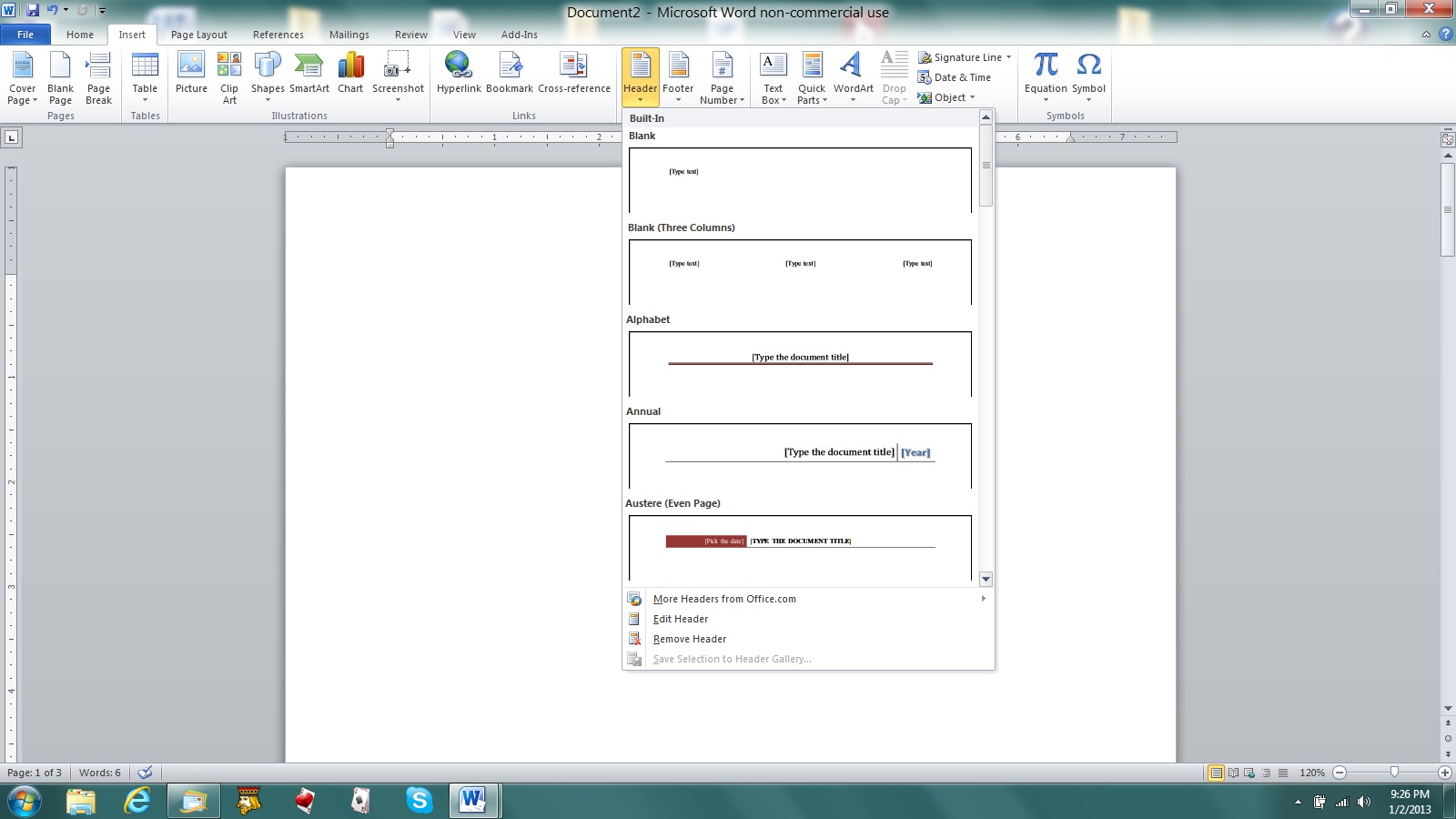
2) Select the Header icon on the Insert page. Make sure your cursor is on this Title Page.
 
3) From the dropdown box, choose "Blank" . . . this will open the "Header and Footer Tools" menu.
 
Notice the BLANK box on top in the dropdown box.
 
 
4) In this new menu, check the box "Different first page" . . . this allows you to setup a cover page header that does not include a page number.
 
Notice the green menu on top. Check DIFFERENT FIRST PAGE
 
5) Enter your book title and author name. It will automatically be left justified. If you wish to change to center or right-justified, highlight it and use the left/right/center justification icons on the “Home” toolbar to position your title/author in your header where you want it. Suggestion: choose the same justification for the header page as you plan to use for the rest of the document, and BE SURE to look at the submission guidelines in case they specify an orientation.

6) Next, use the slide at the right side of the page to slide down to the top of the actual page one of the manuscript.
 
7) Select the Page Number box on the upper left toolbar. Choose the style and location of page number that you like best. I prefer simple right-justified page numbers instead of anything fancy. Also, most agents and editors are NOT impressed with glitzy fonts or unusual formatting.
 
Add the page numbering format first.
 

8) This page will show the number "2" because the program counts all pages, including the cover page. To correct this, go back into the Page Number box and click on Format Page Number. In this box, enter the starting number "0" and it will produce number "1" for your first story page.
 
Format the number using the Format Page Number menu.
 
 
9) Now, highlight the inside edge of the page number and enter your story/author name. You can then use the TAB key to position that information in the center or opposite side of the header from the page number. If you are tabbing to the left, be sure to use Shift Tab, instead of Tab.
 
Use the TAB or Shift TAB key to position Title/Name.
 
 
10) One last tip:  if you use the space bar instead of the Tab key to position the title/author to the margin opposite the page number, be sure to leave two or three spaces between the characters and the margin. As page numbers move from one digit to two, or two to three digits, you might exceed the spaces available on the line, thereby forcing your page number onto the next line. To prevent this, be sure to leave three character spaces between the info and the margin.
 
And . . . here is the finished product!
 
Cover Page with no page number
First page beginning with Page 1


Monday, December 24, 2012

Holiday Greetings and Other Thoughts

Forgive me if this blog is not about writing. For the first time in many years, all my kids and grandchildren will be together this Christmas at my house. In addition, I am reviewing a great contract offer to publish my book, Maker of Angels. What a wonderful holiday for me and my family.

Despite my good fortune, I can't help but think of the pain suffered by some families this year. What must Christmas be like for those who lost a loved one in the Connecticut school shooting, or the family of my old friend, Alvin Pugh . . . he dropped dead of a massive coronary a few days ago. Two young boys in my town, brothers walking their bikes down the side of the road, were killed by a drunk driver a couple months ago. Even families of soldiers killed in Afghanistan this year, how do they find peace and happiness this Christmas?

I don't have answers. Wish I did. All I can do is to take a few minutes out of my own happiness, to think about those who are suffering and respect their loss by memorializing the lives of their loved ones. So while I am having the most wonderful holiday season ever, I am trying to think good thoughts for those who have been less fortunate in hope that Karma really exists.

Merry Christmas or Joyous Holidays to everyone.

Wednesday, December 19, 2012

Dealing with Disaster

I thought my current manuscript, Maker of Angels, was done when I recently submitted it to two publishers for consideration. I was WRONG!

Not wrong about it being submitted, sure enough, I got it into the hands of decision-makers. What was wrong is that the manuscript is not DONE. After countless edits by me and reviews by six beta readers (including two professionals, two writers, one cowboy and an up-and-coming copy editor), I found a glaring spelling error that none of us caught.

Disaster!

"How could something like this happen?" I thought. "More importantly, what am I going to do about it?"

What's my terrible mistake? I wrote a western romance and failed to spell "corral" correctly. Can you believe such a stupid mistake? Corral, a common western word and I messed it up. Yikes! That word showed up nine times in the whole document, and I spelled it "c o r a l" . . . EVERY STINKING TIME.

I feel like a fool. I even recall questioning that spelling while I was writing and made a mental note to check on it in the first edit. Then, I forgot, not once, but through half a dozen edits.
 
Should I keep silent? Should I hope it slips past the acquisition editor like it did everyone else? After all, it has already passed more than a dozen eyes without notice?

Honesty is the best policy, or at least, I hope so. Here's what I did. I sent out the corrected manuscript along with a brief note of apology to the editors involved. I'm owning my mistake. Will my faux pas kill my chances for a contract? I hope not, but we'll see. I'll let you know when decisions are made.

I need a Snickers. They make everything better!

Sunday, December 16, 2012

Page Turners...Structure, a Secret to Pace

Page turners, those books that readers love, come from balance between four elements:

1. Great plot,
2. Compelling characters,
3. Strong story-telling, and,
4. Writing structure/pace.

This blog discusses number 4, "Writing structure and how it enhances pace."

Consider the following excerpt.

     Footprints showed in the morning dew on my lawn, one set leading to my daughter's window and another back to the sidewalk. She had not been imagining that face several times recently. "I'm sorry, Emma. You're right." I felt terrible for doubting her, much less for telling her so.
     "It's okay, daddy." She took my hand and gave it a forgiving squeeze. Her head tipped to one side coming gently to rest against my arm. What a wonderful child, I thought.
     I called the police and took numerous pictures of the footprints from a distance to preserve evidence in case cops arrived after the dew evaporated.

     Police still had not shown up an hour later, and rising sun made short work of the moisture on the grass. "Honey," I called to my nervous wife on the porch, "call the cops again, and find out how much longer until they get here." She went into the house with an exasperated huff. I was sure they were about to get an earful.
     Police arrived just as she returned, and I quickly explained my concern about the stalker with an obsession toward my daughter. "Officer, kids in the neighborhood call him 'Wacky Willie' because he talks to himself all day long down in the park by the school."

That scene mixes dialog and narrative in larger paragraphs. I see writing like this all the time, occasionally even in New York Times Bestselling novels. Can a writer build strong characterization and tension in this way? Sure, but I believe it could be much better if the dialog and narrative are featured separately.

Narrative is best for building scenes while dialog drives plot and enhances tension. When dialog is buried inside paragraphs that are primarily narrative, it loses some of its impact on readers. It also creates longer paragraphs leaving less "white space" on each page. Empty space helps readers to turn more pages per hour giving an impression of a fast-moving story.


Here is the same excerpt from above restructured to add white space and to isolate dialog for greater impact.

     Footprints showed in the morning dew on my lawn, one set leading to my daughter's window and another back to the sidewalk.
     "I'm sorry, Emma. You're right."
     She had not been imagining that face several times recently. I felt terrible for doubting her, much less for telling her so.
     "It's okay, daddy," Emma said as she took my hand and gave it a forgiving squeeze.

     Her head tipped to one side coming to rest against my arm.
     What a wonderful child, I thought.
     I called the police and took numerous pictures of the footprints from a distance to preserve evidence in case the cops arrived after the dew evaporated. Police still had not shown up an hour later, and rising sun made short work of the moisture on the grass.
     "Honey," I called to my nervous wife on the porch, "call the cops again, and find out how much longer until they get here."
     She went into the house with an exasperated huff. I was sure they were about to get an earful. Police arrived just as she returned.
     "Officer, kids in the neighborhood call him 'Wacky Willie.' He talks to himself all day long down in the park by the school."
     I quickly explained my concern about the stalker with an obsession toward my daughter.

The reconstructed excerpt reads as a fast-paced story. Page after page of easy reading like this makes the reader feel as if the story is a "page turner." Assuming that plot tension, character development and story-telling are good, this last structural adjustment can turn a great story into a word-of-mouth best-seller.

What do you think about separating narrative and dialog?

Monday, December 3, 2012

Rising Tide Theory – Edit or Sink!


President John Kennedy coined the expression, “A rising tide lifts all boats.”  He meant that improvements in the economy lifted all citizens, but his concept has wide application. What does this mean to writers?


Rising tide will float all boats
Less than a decade ago, there were no
e-readers, no e-books and no widespread self-publishing. Aspiring authors suffered little possibility of ever seeing their ramblings in published form unless they paid far too much to a vanity press for a garage full of books that would never sell. For most, the dream truly was little more than a fantasy.

Along came internet publishing. E-book readers quickly followed, along with dire projections of the end of traditional publishing. “Bookstores will go bankrupt.” “Mainstream publishers will die on the vine.” “Big name authors will suddenly discover stiff competition for a rapidly dwindling share of the reader market.”

Any town crier in medieval times would be proud of the loud proclamations of doom and gloom.

What really happened?

Some predictions did come to pass. One large bookstore chain, Borders, closed their doors, but it had little to do with growth in self-publishing. They were managed by stupid people who made bad business decisions. "Used book” stores have seen sales dwindle with the advance of e-readers. Many, including my favorite, have closed their doors. New “authors” did indeed explode onto the literary scene in such numbers that most vanished into a cacophony of unknown talking heads. A tiny few soared to great heights on the backs of fiction that went “viral.”

Big publishing houses seemed to ignore the growing changes. They stood in the muddy swamp of traditional literature like dinosaurs casually chewing on literary leaves while staring in mindless wonder at the glowing spot in the sky above, an approaching ten-mile-wide meteor. I suspect they thought all this self-publishing was hoopla, a passing bubble in time that would burst, leaving behind a sticky residue of dwindled hopes and failed dreams. Boy, were they wrong!

Ironically, traditional publishers might just be the big winners in all this literature evolution. “How is that?” you ask.
 
Will YOUR boat float when the tide hits?
Self-publishing created a vast pool of substandard writing foisted off on the public by catchy graphics and low prices. Took a little while, but readers finally caught on. Even “free” books are not getting the downloads that they once did. Price used to be a major factor in book sales. No longer. Consumers figured out the REAL price of an e-book . . . their own time. Bad writing, poor editing and over-hyped, under-delivered e-books have left them cautious about wasting precious free time on crap. For a dollar or two more, a properly edited, well-written e-book from a publisher with strong writing standards can immerse a reader in a wonderful world of suspended reality.

This is where traditional publishers come back into the picture. Historically, competition among authors, and strict editorial standards, resulted in quality books. Readers could always trust what they were getting. As the newness of the e-book craze matures, demand for superior writing is returning, yes, even for $2 e-books. Prices for electronic downloads dropped so low that the only major decision for a reader now is how to spend their limited pleasure-reading time.

Big-(number of the month) publishers are now aggressively positioning to enter POD and self-publishing markets. Their reasonably priced, strongly edited offerings will capture a large share of the consuming public in the near future. Authors who avail themselves of services by such mainstream companies and smaller publishers that also maintain high expectations will produce the higher standard of books that readers crave. The future belongs to quality . . . sales will follow.

Promotions, professional graphics, direct sales from reputable publishers (eliminating the cost of distribution through Amazon or B&N) are necessary, but, most importantly, writers/authors who are smart enough to invest in high quality editing will thrive. All others will find water spilling into their metaphorical boats as the tide rises.
 
Leaky boats don't float!
 
There you have it. Great writing and quality editing is more important than ever. That rising tide WILL, indeed, lift all boats, but only those that are seaworthy. My advice to my fellow writers is simple. Get professional editing . . . the tide's coming, so make sure your boat doesn’t leak!

Sunday, November 25, 2012

Dink - What’s in a Name?

One of my followers asked about my pups, particularly the one called Dink.

“How did you come up with a name like that?” she asked.


Dink - my writing partner sits
by me on his hassack
 
Dink was actually a gift to my wife, Sue, on
one of those “special” birthdays. Blond miniature Dachshunds are rare, and his personality dripped with affection. My wife wrestled with names for him until she settled on a tough-guy name, Axel, and planned to get him a collar with bulldog-style pointed studs. Sure, the little guy was hung like a bull, walking bowlegged to deal with his natural endowment, but her macho name for him simply did not fit his diminutive size and gentle character.

He loves everybody.
During my twenty years as a pro bass fisherman, I spent weekends trying to find the biggest fish possible to win as much as $50,000. Small fish annoyed us and got tossed back as “dinks” that wasted our time. I jokingly called Sue’s puppy Dink, because he was so small. His head popped up and ears tilted forward at the first sound of that name. He liked it.
 
Dink never did answer to that name Sue gave him, but he responded immediately to the derogatory small fish term. It stuck. To this day, his tail wags instantly when he hears his name. More importantly, his sweet disposition never changed. As I type this, I am sitting on my living room couch with Dinkie right beside me. He’s waiting for me to drop my arm enough that he can lunge up to my face and slam his cheek against mine. It’s his way of hugging . . . he can’t get enough. His name definitely fits his temperament.

What’s in a name? Do names carry expectations? Can they convey images to readers?

I think so, but writers need to understand that their personal biases may not be shared by others. If you had an arch nemesis in high school named Buddy, would your life-long distaste for that name carry the same feeling for your readers? Jazmin came to mind for me recently when looking for a special female literary name. My wife liked it, but when I ran it by another friend, she laughed and asked, “Why do you want to use a stripper name?” She even yelled across the room to her husband, asking what he thought of the name. “Stripper!” he yelled back without hesitation.

Would Luke Skywalker have been as compelling if he was named Willy Bangwater? How about Harry Potter? What if he was named after a local pub owner . . . say, Jon Smith?

In my opinion, names will not make or break a character—only the story will do that. But, I do believe carefully selected names enhance a character and make the story more memorable for readers.

That said, do you have a favorite character in literature? If so, how much influence did his or her name have on your impression?

Thursday, November 22, 2012

Y'all Come Set a Spell - Accents/Slang

Consider the following excerpt and the questions that I presented to the Chicago Manual of Style online forum for editors:

My uncle grew up in the hills of Arkansas. His regional dialect often forced me to listen intently as if he spoke a foreign language. I struggled to understand him.

"Boy, ain't no self respect’n coon dog gonna run ’way fumma fight wid'a possum. You gotta be quick on the trigga, an’ shoot that critta 'fore yer dog takes a whuppin."

Notice the fragmented words, phonetic spellings and inconsistent punctuation. Readers might struggle with the uncle's speech pattern, yet the writer wants to create an image that requires such deviations from normal English. If readers stumble on passages like this, they may close the book instead of enjoying the unique voice of that character. I posted the following questions to the editors:

1) How should I use the apostrophe in slang words like "respectin"...should it be respectin' or respect'n or no comma at all…respectin? What about blended words like "dont’cha" for don't you? Would you use an apostrophe at the beginning of a word that drops the "h" as in cockney slang..."C'mon mate, 'ave a 'eart. Poor bloke, ‘e got blowed up in the bloody war. Ain’t got no ‘ands.”

2) When using slang or dropping letters to produce accents (like dropping the "g" in words ending in "ing,") how much is enough? Should the character's speech pattern remain constant throughout the manuscript, or is it enough to suggest a speech pattern initially and return to conventional spellings thereafter?

Here is an answer to my questions from a senior editor at a major publishing house:

“Great questions, Dean!

1. I'd use the apostrophe where it's obvious that a letter is missing. It will help readers follow the dialect so they can better understand what the character is saying.

2. If the character switches back and forth from dialect to no dialect with direct quotes, that will be a red flag to readers and confuse them. Does the character actually speak like this or not? I'd maintain consistency with the character's speech pattern, but I'd also limit the direct quotes wherever possible so they don't exhaust readers.

Of course, it all comes down to being a stylistic thing. Creative writing can take whatever direction the author wants it to, including the punctuation (or lack thereof) with dialects. I find dialects that omit letters easier to read when they have apostrophes. Some authors prefer the stark plainness of omitting them. Sometimes the choice depends on the type of dialect, the character, and the overall storyline (and the anticipated audience).”

 
What about the bible of editing . . . the Chicago Manual of Style? CMOS, section 7.31, discusses such contractions.  Examples they give are:

singin’
meet’n
’tis (not ‘tis)
dos and don’ts
rock ’n’ roll


What do we writers conclude from both the editor’s comments and the formal CMOS discussion/examples?

My conclusion is that CONSISTENCY TRUMPS STYLE.  That said, which of the possible slang-contraction styles would you choose?

sing’n
singin
singin'

Personally, I like the first and third because the apostrophe simplifies the word for the reader. It indicates missing letters and ushers the reader along the without momentary hesitation that might be caused by a reader wondering if the spelling was a typo. More importantly, pick one style and stick with it throughout the manuscript.

There is one exception for me to that self-imposed "rule" on consistency. Endearments. They don't require an apostrophe.

"Darlin, it's real sweet of you, fixin' that broken fan belt, but I'm still not gettin' in bed with you."
 
What about quantity of colloquial words? How many apostrophe’d words or phonetically written expressions are really needed to get across an accent or colloquial speech pattern? Will too many annoy or distract readers? YES!

In my opinion, the real trick for a writer is to find balance between enough slang to get across the intended mental image but not so much that the reader becomes bored, distracted or annoyed.

Here's my own simple rule. The first time you meet my character you will get full immersion in his or her dialect. Every time thereafter, I limit such words to a maximum of one or two such words per sentence; just enough to keep the special voice of that character consistent but not enough to become frustrating to the reader.
 
 
How about you? How do you handle accents and dialect?

Sunday, November 18, 2012

Jihad: The Breath of God

Status of my current thriller story. It is being reviewed by mainstream publishers, including Random House. I will announce the publication and release dates as soon as I sign a contract. Until then, here's a little tickler about the story.

Jihad:  The Breath of God (thriller genre)

In a desperate attempt to get bribe money for his daughter’s needed heart surgery, Dr. Rudenko, a Russian bio-weapon research scientist, sells a genetically modified form of small pox to Pakistan through a clandestine operative. The lethal virus gets diverted into terrorist hands and smuggled out of Afghanistan to a replication laboratory hidden in Mogadishu, Somalia. After testing the virus on a village in the Hindu Kush Mountains, suicide terrorists attack the US and our western allies. Their attack exploits weaknesses in current airport security.

Dr. Kati Ruden, a brilliant virologist with specialization in small pox, is suspended by the CDC for her unauthorized publication of a controversial article about global warming and the possible release of the lethal virus from melting permafrost. The first case of terrorist-caused small pox surfaces, and officials are quick to brand her the top suspect, pointing out that she had access to live small pox and is a disgruntled ex-employee. FBI and Homeland security agents pursue Kati relentlessly as she outwits them at every turn.

Death tolls rise quickly as the highly contagious virus spreads.

Jake Thorn, Kati's fiance, is an ex-black ops specialist operating a team of former military specialists called G.H.O.S.T. (General Hazard Onboard Security Team). While protecting cargo ships from pirates in the Indian Ocean near Somalia, his team investigates radio reports out of Mogadishu about strange deaths. They find the virus lab in the city and sneak in late at night. Kati reviews pictures of the equipment along with detailed reports and immediately understands the nature and scope of the terrorist threat. She also discovers that DNA was altered in this bio-weapon form. Traditional methods to eradicate small pox will not work.

Government leaders attempt to stop the spreading epidemic using out-of-date vaccines and ineffective quarantines. Kati’s warnings are ignored. She desperately needs to clear her name so she can get back into her lab and work to save millions. Despite the rapidly spreading virus, bureaucrats continue to reject her story . . . until she gets help from a prominent freelance journalist. He takes her claims seriously and gets widespread attention from the media. Even the president of the United States becomes involved.

People are dying. Government quarantines collapse interstate commerce. Stock markets close indefinitely, and the world economy grinds to a halt. Gangs in cities and survivalists in the countryside fight against martial law. Chaos, death and panic spread worldwide.
 
Will Kati find a cure? Will Jake and his team destroy the lab? Are YOU safe? This story is not a fictional account about what might happen. It is a prediction about what WILL happen in the future of terrorism.
 
Reserved copies:  When the book is published, the first 100 copies will be numbered and signed. If you are interested in getting on the reserve list, please send your name and contact information to:

AuthorDSault@comcast.net

Sunday, November 11, 2012

Hard at Writing? (The obsession)

Time is precious. As I get older, a twenty-four hour day seems terribly inadequate. Why can’t I have thirty-six hours in a day, or better yet, a life-pause button that can stop precious seconds from frittering away?

Writing and time go hand in hand. Sometimes, I start writing on a Friday evening and only come out of sequester for nature breaks or snacks until late on Sunday. Okay, that’s not completely true . . . I can’t stand fur jackets on my teeth, so I also brush regularly. When I get tired, I pull the recline-lever on my writing chair, lay my head back and nap for an hour or two. I often awaken inspired by a dream, or some plot complexity percolates up from those hours of subliminal processing.
 
Hard at writing!
 
Do I have a life outside of writing? Of course, but priorities must be set lest my passion become destructive to people I love and others I care about.

Writing vertigo – that’s what I call it—a spiraling loss of balance centered around my passion for creating stories. It threatens relationships, pulls me away from my “day job” and leaves me grumpy about every day activities. I often lose track of topics in the middle of conversations when a plot device suddenly invades my thoughts.

“Thanks for thinking of me, but I just don’t have time.” I say that entirely too much when asked to participate in non-writing activities. Even my 45-year love of playing guitar waned recently as I dove deeper into half a dozen new manuscripts.

Does my love of writing teeter on some brink between high productivity and destructive obsession? Perhaps.

Balance is the theme of this blog. Writing can be very rewarding. It allows creative expression and provides the same escape from reality as our readers seek in our books. But, writing might also morph into an unhealthy obsession, harming other parts of our lives. Do you ignore your kids or spouse to write? Have you ever called in sick to gain time for writing? Will you interrupt your writing for exercise, to eat healthy or to take your dog for a walk?

How do we . . . do I . . . discover that elusive balance between productivity and unhealthy addiction?

Damned if I know. I’d love to hear your thoughts on the matter.